

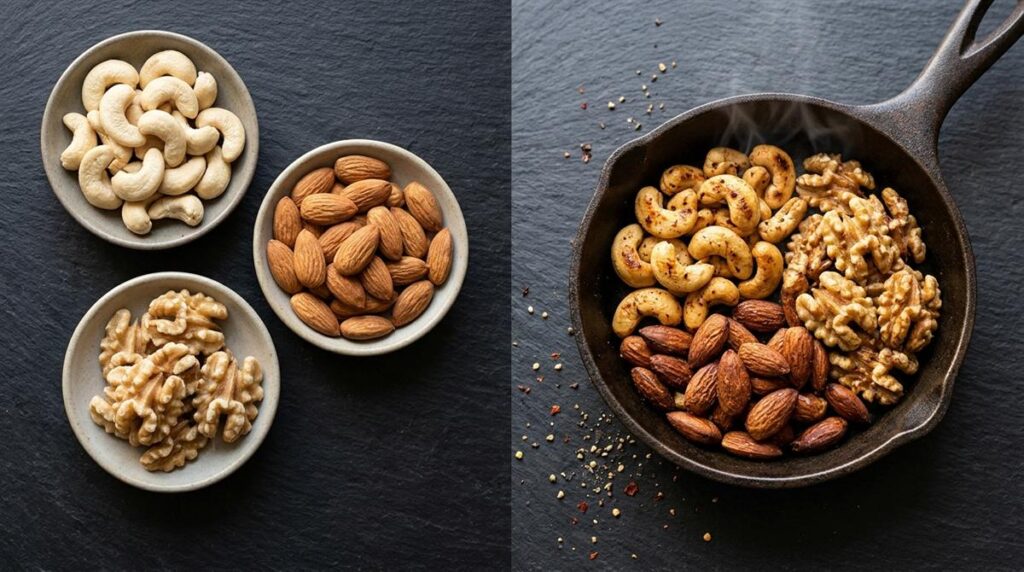
When reaching into the pantry, health-conscious snackers often face a classic choice: pure, unroasted raw nuts straight from nature, or aromatic, golden dry-roasted nuts seasoned to perfection. For years, wellness blogs have debated whether roasting “kills” the delicate enzymes and healthy fatty acids in nuts, while food lovers rightfully insist that unroasted varieties simply lack that satisfying, stress-relieving snap.
Does heat really diminish the nutritional value of your favorite nuts, or does slow, artisanal roasting unlock unique digestive benefits? At Sahyadri Nuts-where we’ve perfected gentle nut roasting and traditional grading techniques since 1978-we dive into food science to clear up the confusion.
1. The Calorie & Macronutrient Verdict: What Changes?
When nuts are roasted without added industrial oils, their fundamental macronutrient profile remains remarkably consistent. A standard 28-gram serving of raw almonds contains approximately 160 calories, 6 grams of plant protein, and 14 grams of healthy fats. A batch of slow-roasted almonds clocks in virtually identical numbers (around 165 calories and 6 grams of protein).
The subtle difference comes down to water evaporation: gentle heat drives out residual moisture, making roasted nuts marginally more nutrient-dense per gram. The heart-healthy monounsaturated fatty acids (MUFAs) that make almonds and cashews renowned superfoods are chemically resilient and stay intact under controlled roasting temperatures.
2. What Really Happens to Vitamins and Minerals Under Heat?
The popular myth that “heat destroys all nutrition” ignores how different nutrients react to temperature:
- Minerals Are Heat-Proof: Essential minerals like magnesium, potassium, iron, and zinc cannot be broken down by roasting temperatures. Whether you choose raw cashews or savory roasted varieties, your body absorbs the exact same bone- and muscle-supporting mineral payload.
- Vitamin E (Alpha-Tocopherol): Vitamin E in almonds is moderately heat-sensitive. Prolonged roasting can reduce active Vitamin E by 10% to 15%. However, rotating freshly roasted Roasted & Salted Almonds with raw varieties still provides over 30% of your daily Vitamin E requirement in a single handful.
- Enhanced Antioxidant Bioavailability: Controlled heat gently breaks down tough plant cell walls, which can actually release bound polyphenols and flavonoids, making them more accessible for your digestive system to absorb.
3. Dry Roasting vs. Oil Frying: The Real Health Distinction
When you hear nutritionists warn against “roasted nuts,” they are usually referring to commercial oil-fried nuts. Mass-market snack brands frequently deep-fry nuts in low-grade palm or refined vegetable oils at extreme temperatures, infusing them with unwanted trans-fats and rancid oils.
In contrast, authentic hot-air dry roasting uses zero added oil. By allowing the nut’s own intrinsic natural oils to toast the outer layer, dry roasting produces a crisp, clean bite with zero hidden saturated fats.
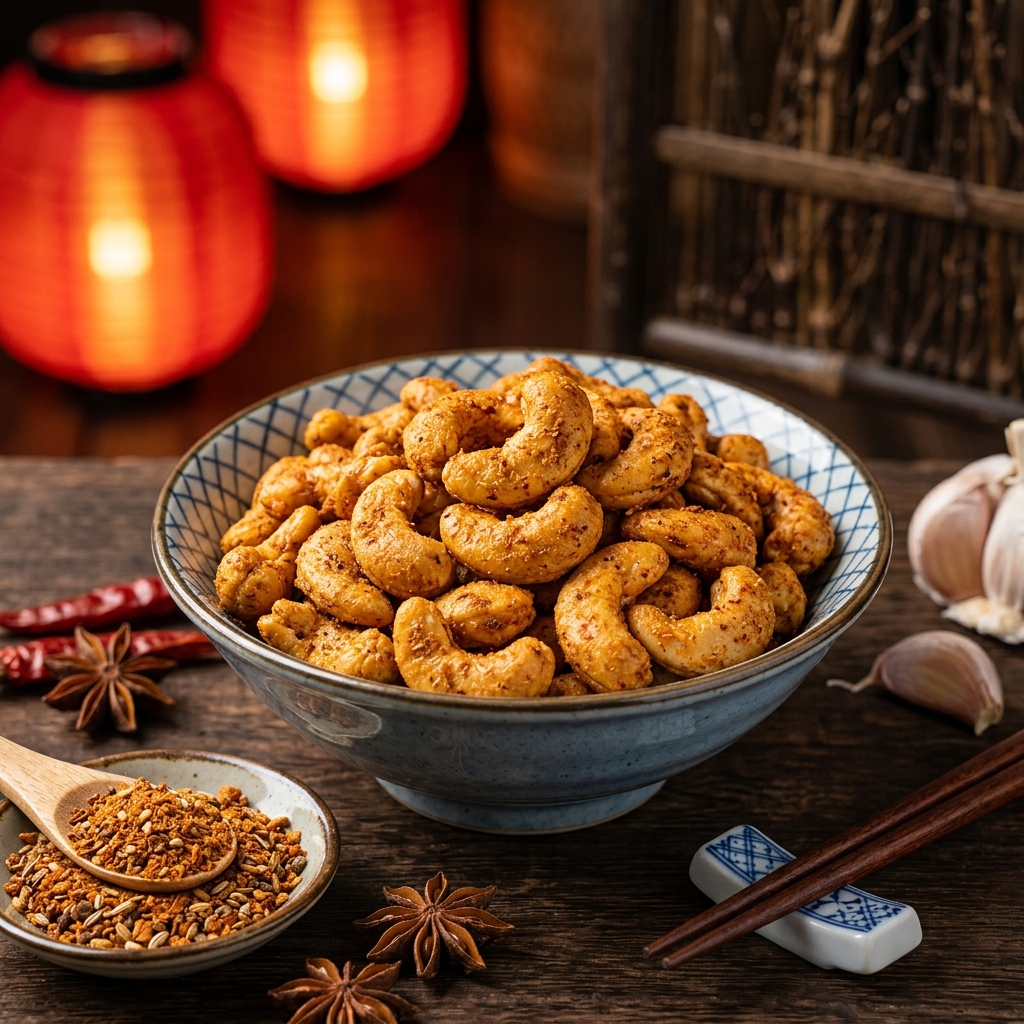
At Sahyadri Nuts, our flavored range takes dry roasting to the next level by seasoning small batches with authentic regional herbs and spices. From the earthy, coastal aroma of Curry Leaf Cashews (infused with real crisp curry leaves) to the fiery kick of Schezwan Cashews and warm Black Pepper Cashews, you get guilt-free artisanal crunch crafted without deep-frying.
4. Digestion & Phytates: Why Roasted Nuts Can Be Gentler on the Stomach
Raw nuts contain natural phytic acid (phytates), which act as an antioxidant shield for the seed. In the human digestive tract, phytates can bind to minerals like iron and zinc, moderately dampening their absorption. Roasting acts as a natural enzymatic neutralizer, breaking down phytates so your body can absorb minerals more efficiently.
Furthermore, dry roasting alters the physical density of the nut. While raw nuts require vigorous chewing, roasted nuts crumble easily into fine particles during mastication, making them noticeably gentler on sensitive digestive systems.
5. The Smart Snacking Strategy: How to Balance Both
You do not need an “all-or-nothing” approach. The most sustainable wellness lifestyle combines the best of both worlds:
- Morning Fuel (Raw & Natural): Start your day with soaked California Almonds or smooth raw Plain Jumbo W180 Cashews to deliver steady, sustained energy and peak Vitamin E on an empty stomach.
- Workout & Midday Cravings: Keep a pocket-sized jar of Salted Almonds in your gym or office bag. The subtle touch of salt replenishes essential electrolytes lost through sweat, while the protein curbs sudden hunger pangs.
- Evening Chai & Social Snacking (Flavoured Cashews): Replace oily fried namkeen, chips, or biscuits with gourmet dry-roasted Curry Leaf Cashews or Schezwan Cashews. You get the crunch and regional spice of street snacks with pure, wholesome nut nutrition.
Frequently Asked Questions (FAQs)
Q1: Are dry-roasted nuts as healthy as raw nuts?
Yes! As long as they are truly dry-roasted without cheap refined oils, roasted nuts provide almost identical amounts of protein, fiber, healthy monounsaturated fats, and minerals (such as magnesium and zinc). While roasting slightly reduces heat-sensitive Vitamin E by about 10-15%, it also deactivates phytates, enhancing overall mineral absorption.
Q2: Do roasted nuts have more calories than raw nuts?
Gram for gram, dry-roasted nuts have only a negligible calorie difference (around 5 calories more per 28g serving) simply because roasting removes moisture, concentrating the nut slightly. However, if nuts are deep-fried in vegetable oil (common in commercial snacks), their calorie and unhealthy fat counts increase substantially. Always opt for oil-free dry-roasted nuts.
Q3: What makes Sahyadri’s Curry Leaf and Flavoured Cashews special?
Unlike conventional snacks that use artificial flavoring powders and high-sodium binders, our Curry Leaf Cashews and spiced varieties are slowly dry-roasted and infused with genuine culinary herbs and real spices. You experience an authentic crunch that complements Indian palate traditions without any deep frying.
Q4: Why do raw almonds sometimes upset my digestion?
Raw almond skins contain tannins and phytic acid, which can make them harder to break down for some individuals, causing bloating or sluggish digestion. If you experience discomfort with raw almonds, either soak them overnight and peel the skin, or switch to dry-roasted varieties like Roasted & Salted Almonds, where heat has naturally softened the cellular structure.
Q5: How should I store dry-roasted and flavored cashews to keep them crisp?
Because dry-roasted nuts have had their moisture removed, they easily absorb ambient humidity if left exposed. Keep your Flavoured Cashews in an airtight glass container or zip-lock pouch in a cool, dark pantry. Avoid storing them near strong-smelling spices, and do not refrigerate unless sealed completely airtight.
Discover Sahyadri’s Dry-Roasted & Raw Collections
From sweet, hand-graded raw whole kajus to bold, small-batch spiced delicacies, find your perfect crunch:
- For South Indian Herbal Crunch: Curry Leaf Cashews (250g)
- For Bold Evening Snacking: Schezwan Cashews (250g)
- For Warm Peppery Crunch: Roasted Black Pepper Cashews (250g)
- For Savory On-the-Go Fuel: Roasted & Salted Almonds (250g)
- For Pure Raw Goodness: Plain Jumbo W180 Cashews (250g) & California Almonds (500g)