

Seeds are often called tiny nutritional powerhouses—and for good reason. Pumpkin, sunflower, flax, chia, sesame, and watermelon seeds each offer different nutrients. But does combining them make mixed seeds a better choice than eating just one type?
The short answer: mixed seeds can be more nutritionally diverse, but single seeds can be equally useful depending on your dietary needs.
What Are Mixed Seeds?
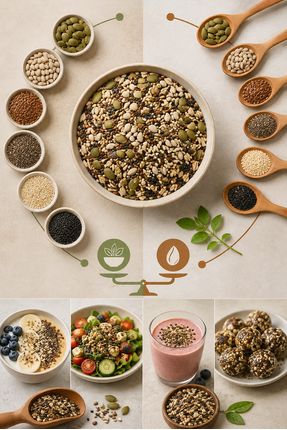
Mixed seeds are a combination of two or more edible seeds, commonly including:
- Pumpkin seeds
- Sunflower seeds
- Flax seeds
- Chia seeds
- Sesame seeds
- Watermelon seeds
Because different seeds contain different nutrients, combining them can provide a broader nutritional profile in one serving.
Mixed Seeds vs. Single Seeds
| Nutritional Benefit | Mixed Seeds | Single Seed |
| Nutrient variety | ⭐⭐⭐⭐⭐ | ⭐⭐⭐ |
| Healthy fats | High | Depends on the seed |
| Protein | Good | Depends on the seed |
| Fibre | Good | Depends on the seed |
| Convenience | Very convenient | Simple |
| Targeted nutrition | Moderate | Excellent |
| Taste & texture | More varied | Consistent |
Why Choose Mixed Seeds?
1. Greater nutrient variety
Each seed has its own nutritional strengths. For example, flax and chia provide plant-based omega-3 fats, while pumpkin and sunflower seeds are good sources of minerals and protein.
2. More balanced snacking
A combination of seeds can provide healthy fats, protein and fibre, making them a satisfying addition to meals or snacks.
3. Easy way to diversify your diet
Instead of buying and remembering to eat several different seeds separately, a mixed-seed blend provides variety in one serving.
4. Versatile and easy to use
You can sprinkle mixed seeds over oatmeal, yoghurt, salads, smoothies or breakfast bowls—or simply enjoy them as a snack.
When Can a Single Seed Be Better?
Mixed seeds aren’t automatically superior.
If you’re looking for a specific nutritional benefit, choosing one seed may be more practical. For example, flax seeds are particularly known for their alpha-linolenic acid (ALA), a plant-based omega-3 fatty acid. Chia seeds are also rich in fibre and ALA, while pumpkin seeds provide protein and minerals.
So, rather than asking “Which is better?”, a better question is:
“What nutritional variety does my diet need?”
How Much Mixed Seeds Should You Eat?
For most people, around 1–2 tablespoons a day is a practical serving size. Seeds are nutrient-dense, so a small portion can add meaningful nutrition without becoming excessive in calories.
If you’re new to seeds, start with a smaller amount and increase gradually, especially because many seeds are high in fibre.
How to Add Mixed Seeds to Your Diet
Try them in:
- 🥣 Oatmeal and breakfast bowls
- 🥛 Smoothies
- 🥗 Salads
- 🥛 Yogurt or curd
- 🍞 Homemade breads and energy bites
- 🍎 Fruit bowls
- ✨ Homemade trail mixes
Mixed seeds aren’t necessarily “better” than single seeds—they simply offer greater variety.
If your goal is overall dietary variety, a mixed-seed blend can be an excellent everyday choice. If you’re targeting a particular nutrient, a specific single seed may be more appropriate.
The best approach is to include a variety of seeds as part of a balanced diet rather than relying on one type alone.
FAQs
1. Are mixed seeds healthy?
Yes. Mixed seeds can provide a combination of healthy fats, protein, fibre, vitamins and minerals. Their exact nutritional value depends on which seeds are included.
2. Is it better to eat mixed seeds or one type of seed?
Mixed seeds offer greater nutritional variety, while single seeds can be useful when you’re specifically looking for nutrients associated with that particular seed.
3. Can I eat mixed seeds every day?
For most healthy adults, moderate daily consumption can fit well into a balanced diet. A serving of around 1–2 tablespoons is a practical starting point.
4. Which seeds are commonly included in a mixed-seed blend?
Popular combinations include pumpkin, sunflower, flax, chia, sesame and watermelon seeds.
5. Should mixed seeds be roasted or eaten raw?
Both can be consumed. Light roasting can improve flavour and texture, while excessive heating may affect some heat-sensitive nutrients. Avoid heavily salted or sugar-coated varieties when possible.
6. Can mixed seeds help with digestion?
Seeds contain dietary fibre, which supports normal digestive function. However, increase fibre gradually and drink adequate fluids.
7. Can children eat mixed seeds?
Many children can include seeds as part of a balanced diet, but whole seeds can be a choking hazard for young children. Use age-appropriate forms and follow appropriate feeding guidance.
8. What is the best time to eat mixed seeds?
There is no single “best” time. They can be added to breakfast, snacks, salads or meals according to your routine.
9. Can I add mixed seeds to smoothies?
Yes. Mixed seeds can be added to smoothies, yoghurt, oatmeal or breakfast bowls for extra texture and nutrition.
10. Are mixed seeds good for weight management?
Seeds can be filling because they provide fibre, protein and fats, but they are also calorie-dense. Portion size matters when including them in a weight-management diet.