

This Independence Day, discover how a nut from Brazil found a home in India—and became a favourite across generations.
When you think of India’s favourite snacks, cashews are likely to be high on the list. From a handful of roasted kaju with tea to rich Indian gravies, festive sweets and modern snack mixes, cashews have become deeply woven into our food culture.
But here’s the surprising part: cashews are not originally from India.
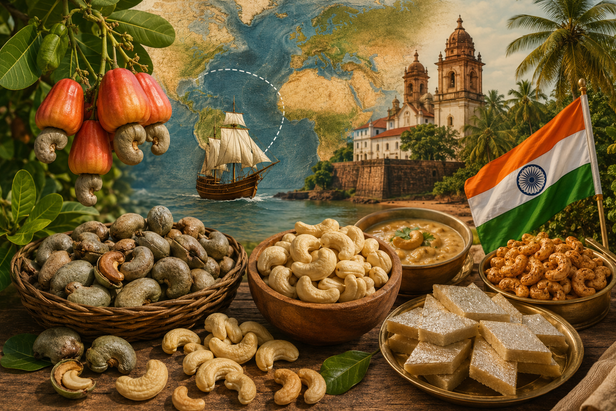
Their journey began thousands of kilometres away in northeastern Brazil. Centuries later, the Portuguese brought the cashew tree to India, where it adapted remarkably well to the tropical climate and eventually became an important crop, ingredient and snack.
This Independence Day, let’s take a different journey through history—from Brazil to Bharat, and from a foreign crop to an Indian favourite.
Where Did the Cashew Come From?
The scientific name of the cashew tree is Anacardium occidentale, and its origins can be traced to northeastern Brazil.
Long before European explorers arrived, Indigenous communities in Brazil were already familiar with the cashew tree and its fruits. The cashew is particularly interesting because what we commonly call the “cashew nut” grows attached to the bottom of the fleshy cashew apple.
So, unlike almonds or peanuts, cashews don’t grow hidden inside an ordinary fruit.
The cashew tree also produces a hard outer shell containing an irritating oil, which means the kernels require careful processing before they become the familiar edible cashews found in stores today.
From Brazil to India: The Portuguese Connection
The next chapter of the cashew story takes us to the 16th century.
Portuguese travellers carried cashew from Brazil to other parts of their overseas territories. Historical and agricultural sources place its introduction to India in this period, particularly in Goa around the mid-16th century.
Interestingly, cashews were not initially brought to India simply because people wanted another tasty snack.
One of their early purposes was soil conservation.
Cashew trees were planted in areas where their roots could help bind soil and reduce erosion, particularly on coastal and hilly terrain. Over time, however, the tree proved to be much more valuable than its original purpose suggested.
The warm and tropical conditions of many parts of India suited cashew remarkably well.
And that is where the story began to change.
A Foreign Tree Finds an Indian Home
Once introduced, cashew gradually spread across suitable regions of India.
Today, cashew is cultivated across several states, including Goa, Maharashtra, Karnataka, Kerala, Tamil Nadu, Andhra Pradesh, Odisha and West Bengal, along with some other suitable regions.
What began as an introduced crop eventually became part of India’s agricultural landscape.
And something even more interesting happened next.
Cashew became part of Indian food culture.
From Kaju Curry to Kaju Katli
Indian cuisine has a remarkable ability to make ingredients its own.
Cashews found their way into rich gravies, pulao, biryani garnishes, festive dishes and sweets. Cashew paste can add creaminess and richness to recipes, while whole roasted cashews bring texture and crunch.
Then there is the unmistakable kaju katli—one of India’s most loved cashew-based sweets.
During festivals, weddings and celebrations, cashews also became associated with gifting, hospitality and prosperity.
In other words, the cashew was no longer simply an introduced crop.
It had become a part of the Indian kitchen.
From Traditional Ingredient to Modern Snack
The journey didn’t stop with traditional Indian cuisine.
As food habits evolved, cashews moved from the kitchen shelf to the snack box.
Roasted cashews, salted cashews, spiced varieties and flavoured snack formats have made it easier to enjoy them as an everyday snack. India’s modern cashew industry has increasingly embraced value addition—transforming the same familiar nut into products with different flavours, textures and uses.
Today, flavoured cashews can go far beyond simple salt and pepper.
The Indian Cashew Industry Gets Creative With Flavours
One of the most interesting developments in India’s cashew industry is the rise of flavoured cashews inspired by Indian and global tastes.
Processors and snack brands can roast cashews and then season them with carefully developed spice blends, herbs and flavourings. This has opened up a much wider world of cashew snacking—from familiar masala profiles to more contemporary flavours.
Some flavour concepts take inspiration from popular Indo-Chinese favourites such as Manchurian-style cashews, where the nut gets a savoury, spicy and tangy profile. Depending on the formulation, such products may use ingredients such as chilli, garlic, spices, herbs and flavour enhancers such as MSG to recreate the characteristic Manchurian taste.
At the other end of the spectrum are flavours rooted more directly in India’s regional pantry. Curry leaf cashews, for example, bring together roasted cashews with the unmistakable aroma of curry leaves and complementary Indian spices.
This is where the story of cashew becomes particularly Indian.
A nut that travelled from Brazil is now being paired with flavours that are deeply familiar to Indian taste buds.
Modern brands such as sahyadri nuts are also bringing this flavour-led approach to everyday snacking. Their range currently includes Salted Cashew and Chilli Cashew, showing how cashews can move from a traditional dry-fruit staple into convenient, flavour-forward snacks.
The evolution is simple but fascinating:
Brazilian origin → Indian cultivation → Indian cuisine → modern Indian flavours → convenient everyday snacking.
Beyond Snacking: The Rise of Cashew-Based Products
The modern cashew story doesn’t end with roasted and flavoured nuts.
As consumers look for plant-based ingredients and versatile alternatives, cashews are increasingly being used as a base for a variety of food products.
Cashew Milk
Cashew milk is a plant-based beverage made by blending cashews with water and processing the mixture into a smooth, creamy drink. Its naturally creamy texture makes cashews particularly useful in dairy-alternative applications.
Vegan Cheese
Cashews have also become popular in plant-based cooking because their creamy texture can be transformed into vegan cheese-style spreads, sauces and soft cheese alternatives. When blended with ingredients such as nutritional yeast, herbs, spices and acids, cashews can provide a rich base for dairy-free recipes.
Energy Bites
Another modern application is the energy bite. Cashews can be combined with ingredients such as dates, seeds, oats, cocoa or other nuts to create compact snack balls that are convenient for work breaks, travel or pre- and post-workout eating.
Cashew Butter and Other Innovations
Cashews can also be processed into cashew butter, spreads, dessert fillings, sauces and other value-added food products.
This is an important evolution for the industry.
The cashew is no longer viewed only as a nut to roast, salt or add to a sweet.
It is becoming a versatile food ingredient.
From a crunchy snack to a creamy plant-based ingredient, the same cashew can take on completely different forms.
India’s Cashew Story Is Still Evolving
At the same time, cashew remains economically important to India. According to ICAR, India’s cashew sector supports livelihoods for more than 1.5 million people, particularly through farming and processing activities.
India’s relationship with cashew has therefore grown beyond consumption. It now includes farmers, processors, researchers, entrepreneurs and food businesses.
Modern research is also helping the sector evolve. ICAR’s Directorate of Cashew Research continues to work on cultivation, processing, value addition and new technologies for the cashew industry.
The future of cashew is therefore not limited to increasing production.
It is also about better processing, new flavours, innovative products and greater value addition.
A Journey Worth Celebrating This Independence Day
Independence Day is a celebration of India’s identity, heritage and the many stories that have shaped the country.
The story of the cashew offers an interesting reminder:
Not everything that becomes part of India has to originate here.
Some things arrive from distant lands, adapt to India’s soil and climate, become part of local traditions, and eventually find a place in everyday Indian life.
The cashew is one such story.
Born in Brazil.
Carried across oceans.
Rooted in India.
Reimagined by Indian flavours.
Loved by generations.
And today, whether it is part of a festive sweet, a traditional recipe, a curry-leaf-inspired snack, a spicy flavoured cashew or a modern plant-based product, the humble cashew represents a fascinating journey of how food travels, evolves and becomes part of a culture.
This Independence Day, as we celebrate India, let’s also celebrate the incredible food stories that have travelled across borders and found a home here.
From Brazil to Bharat, the cashew’s journey is truly one worth savouring.
Frequently Asked Questions
1. Where did cashews originally come from?
Cashews originated in northeastern Brazil, where the cashew tree is native.
2. Who brought cashews to India?
Cashews were brought to India by the Portuguese during the 16th century. Goa is regarded as one of the earliest locations where the crop was introduced.
3. Why were cashew trees originally planted in India?
One of the important early reasons was soil conservation. Cashew trees were planted to help control erosion, particularly in coastal and hilly areas.
4. Where is cashew grown in India today?
Cashew is cultivated in several parts of India, including Goa, Maharashtra, Karnataka, Kerala, Tamil Nadu, Andhra Pradesh, Odisha and West Bengal, as well as some other suitable regions.
5. Is the cashew apple the same as the cashew nut?
No. The cashew nut grows attached to the bottom of the fleshy cashew apple. The two are different parts of the same fruiting structure.
6. Can raw cashews be eaten straight from the shell?
Cashews require proper processing because the outer shell contains an irritating oil. Commercial cashews therefore go through processing before they reach consumers.
7. How did cashews become popular in Indian cuisine?
After adapting to India’s climate, cashews became increasingly used in Indian cooking, sweets and festive foods. Today, they are common in dishes ranging from rich gravies and rice preparations to sweets such as kaju katli.
8. What are some popular Indian foods made with cashews?
Some familiar examples include kaju katli, kaju curry, korma, pulao, biryani garnishes and various festive sweets and snacks.
9. How are flavoured cashews made?
Flavoured cashews are generally roasted or processed and then coated or seasoned with spice blends, herbs and other flavouring ingredients. Modern cashew products can range from simple salted varieties to chilli, masala, Manchurian-style and regional herb-inspired flavours.
10. What is curry leaf cashew?
Curry leaf cashew is a flavoured cashew preparation that combines roasted cashews with curry leaves and complementary spices. It is an example of how India’s regional flavours are being incorporated into modern nut snacking.
11. What are some modern products made from cashews?
Cashews can be used to make or formulate products such as cashew milk, cashew butter, vegan cheese-style spreads, sauces, desserts and energy bites, in addition to roasted and flavoured snacks.
12. Is cashew important to India’s economy?
Yes. Cashew supports a large agricultural and processing ecosystem. ICAR reports that India’s cashew industry supports livelihoods for more than 1.5 million people, particularly in farming and processing.
13. How did cashew go from a Brazilian crop to a modern Indian snack?
The journey began in Brazil, continued through Portuguese trade and its introduction to India in the 16th century, and then evolved through Indian agriculture, food traditions, processing and modern snack culture.
Today, cashew is enjoyed in both traditional recipes and convenient packaged snacks—and is increasingly being transformed into new value-added products.
The Cashew Journey at a Glance
🇧🇷 Brazil
Native home of the cashew
↓
⛵ 16th Century
Portuguese travellers carry cashew across the oceans
↓
🇮🇳 Goa
Cashew is introduced to India
↓
🌱 Indian Agriculture
The crop spreads across suitable tropical regions
↓
🍛 Indian Cuisine
Cashew becomes part of gravies, rice dishes and sweets
↓
🌶️ Indian Flavours
Cashew evolves into masala, chilli, Manchurian-style and regional flavour profiles
↓
🥜 Modern Snacking
Roasted, flavoured and packaged cashews become everyday favourites
↓
🥛 Value-Added Products
Cashew finds new applications in milk alternatives, vegan cheese-style products, energy bites, butter and more
From Brazil to Bharat. A journey of centuries, one cashew at a time.