

Introduction
In today’s fast-paced food industry, automation has transformed the way products are processed, packaged, and delivered. From advanced sorting machines to AI-powered quality control systems, technology has made food production faster and more efficient than ever before. Yet, when it comes to premium cashews, hand-sorting remains an essential step that many quality-focused producers continue to value. While machines can process large quantities quickly, the human eye and touch still offer a level of precision that technology often struggles to match. For consumers who care about quality, freshness, and consistency, hand-sorted cashews continue to stand apart.
The Journey of a Cashew
Before cashews reach your snack bowl, they go through several stages:
- Harvesting
- Shelling
- Drying
- Peeling
- Grading
- Sorting
- Packaging
The sorting stage is particularly important because it determines the final quality of the product that reaches customers. Even after machine grading, cashews can still vary in:
- Size
- Color
- Shape
- Surface quality
- Breakage levels
This is where skilled human sorters make a significant difference.
What Is Hand-Sorting?
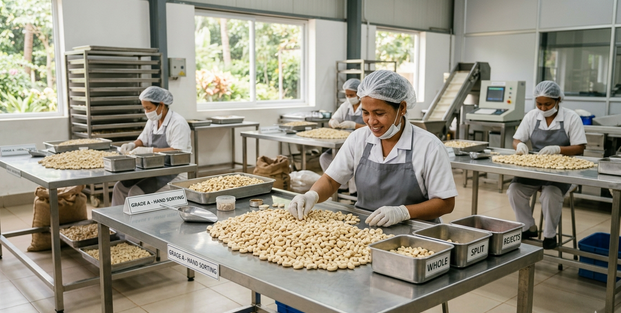
Hand-sorting involves trained workers carefully inspecting cashew kernels and separating them according to quality standards. They identify:
- Whole kernels
- Split kernels
- Broken pieces
- Discolored nuts
- Damaged kernels
- Foreign particles
Each cashew is visually checked to ensure only the best kernels make it into premium-grade packs.
Why Machines Can’t Do Everything
Modern sorting equipment uses cameras, sensors, and algorithms to classify nuts based on measurable characteristics. While these systems are incredibly useful, they have limitations.
1. Human Eyes Detect Subtle Imperfections
Experienced sorters can notice:
- Slight discoloration
- Surface blemishes
- Tiny cracks
- Uneven texture
These details may not always be detected accurately by automated systems.
2. Better Judgment for Premium Grades
Premium cashew grades demand consistency. Humans can make nuanced decisions that machines may classify incorrectly, ensuring a more uniform appearance throughout the package.
3. Handling Natural Variations
Cashews are natural agricultural products. Unlike manufactured items, every kernel is unique. Human sorters can adapt to seasonal variations and changing crop characteristics far better than rigid automated settings.
The Importance of Uniformity
Consumers often judge quality by appearance before tasting the product. A premium pack should contain:
✔ Uniform size
✔ Consistent color
✔ Minimal breakage
✔ Clean kernels
✔ Attractive presentation
Hand-sorting helps achieve this level of consistency, making the product more appealing and trustworthy.
Enhanced Food Safety
Food safety remains a top priority in nut processing. During hand-sorting, trained workers can identify:
- Shell remnants
- Foreign materials
- Damaged kernels
- Unusual defects
This additional layer of inspection complements automated systems and helps ensure safer, cleaner products.
Supporting Traditional Expertise
Hand-sorting is more than just a processing step—it is a skill developed through years of experience. Many cashew-producing regions have built generations of expertise around careful nut grading and selection. By maintaining hand-sorting practices, producers preserve valuable craftsmanship while continuing to deliver premium-quality products.
The Best Approach: Humans + Automation
The debate isn’t really about choosing one over the other. The most successful cashew processors combine:
Automation for:
- Speed
- Efficiency
- Large-scale processing
- Initial grading
Human Expertise for:
- Final quality checks
- Premium selection
- Consistency
- Detailed inspection
This combination delivers the best balance of productivity and product excellence.
Why Premium Brands Still Invest in Hand-Sorting
Brands that prioritize quality understand that customer satisfaction depends on more than efficiency. Hand-sorting helps ensure:
- Superior appearance
- Better consistency
- Reduced defects
- Higher customer trust
- Premium eating experience
When consumers open a pack of carefully selected cashews, they immediately notice the difference.
Conclusion
As automation continues to revolutionize food processing, hand-sorting remains a valuable practice in premium cashew production. Machines bring speed and efficiency, but human expertise adds the attention to detail that defines exceptional quality. The next time you enjoy a pack of beautifully uniform, premium cashews, remember that behind every perfectly selected kernel is often a combination of advanced technology and skilled human hands working together.
Frequently Asked Questions (FAQs)
1. What is hand-sorting in cashew processing?
Hand-sorting is the manual inspection and selection of cashew kernels by trained workers to remove damaged, discolored, or broken nuts and ensure consistent quality.
2. Are machine-sorted cashews inferior?
Not necessarily. Machines are highly effective for large-scale sorting, but hand-sorting often provides an additional level of quality control, especially for premium-grade cashews.
3. Why do premium cashew brands use hand-sorting?
Hand-sorting helps achieve better uniformity, appearance, and consistency while identifying subtle defects that machines may overlook.
4. Does hand-sorting improve food safety?
Yes. It provides an additional inspection step that can help detect foreign materials, shell fragments, and damaged kernels.
5. Is hand-sorting still relevant today?
Absolutely. Many premium cashew producers combine automation with manual inspection to deliver the highest quality products