

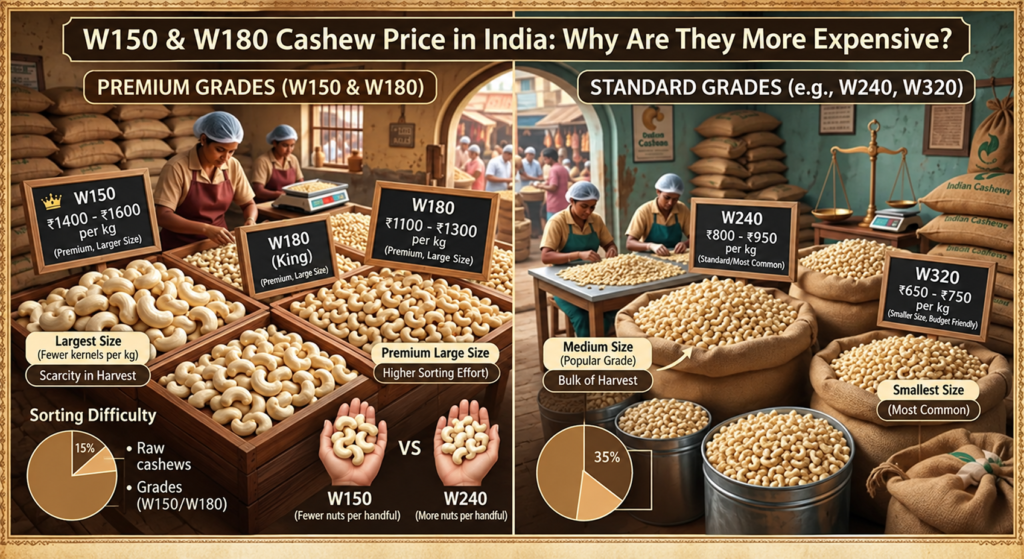
The reason is simple: W150 and W180 are among the largest whole white cashew grades, and larger, well-formed whole kernels are generally harder to obtain during processing.
Cashews are often sold with grades such as W150, W180, W210, W240 and W320. If you have ever compared cashew prices, you may have noticed that W150 and W180 cashews are considerably more expensive than regular grades.
But size is not the only factor affecting the price. Processing yield, quality, availability, demand, sourcing and handling all play a role.
What Do W150 and W180 Mean?

The “W” in W150 and W180 stands for White Whole, meaning the cashew kernel is whole and has the expected white appearance.
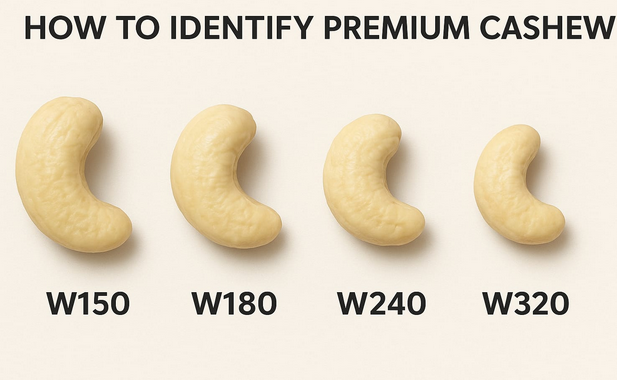
The number refers broadly to the number of kernels found per pound. Therefore, a lower number means larger kernels.
- W150: Approximately 150 or fewer kernels per pound, depending on the applicable grading standard.
- W180: Approximately 120–180 kernels per pound under commonly used grading specifications.
- W210: Approximately 180–210 kernels per pound.
- W240: Approximately 220–240 kernels per pound.
- W320: Approximately 300–320 kernels per pound.
The exact grading range can vary by industry or standard, particularly for W150. The Cashew Export Promotion Council of India (CEPCI) recognizes W150 as an additional size grade, while W180 and other grades are classified according to kernel count.
In simple terms:
W150 → Very large kernels
W180 → Large kernels
W210 → Medium-large kernels
W240 → Medium kernels
W320 → Smaller whole kernels
Why Are W150 and W180 Cashews More Expensive?
1. They Are Larger Cashew Kernels
The biggest reason for the higher price is their size.
A W150 kernel is substantially larger than a W320 kernel. Since consumers often associate larger, attractive whole kernels with premium quality, these grades command a higher market value.
For buyers looking for premium cashews for gifting, premium dry-fruit boxes, hospitality or direct consumption, W150 and W180 can be particularly attractive.
2. Fewer Large Kernels Are Available
Large whole kernels are not as commonly obtained as smaller whole grades.
During processing, cashew nuts must go through several stages, including shell removal, peeling, drying and grading. Maintaining a large kernel without breakage requires careful processing.
When a kernel breaks during processing, it can no longer be sold as a premium whole grade.
This makes large whole kernels more valuable.
3. Whole Kernels Command a Premium
W150 and W180 belong to the whole white cashew category.
A whole, clean and well-shaped kernel generally has a higher commercial value than broken kernels or lower grades.
This is particularly relevant for premium retail packaging, where appearance matters almost as much as taste.
4. Processing Requires Greater Care
Producing premium whole kernels requires careful handling.
Cashews can break or become damaged during shelling and peeling. Processors therefore need appropriate machinery, skilled handling and quality control to maximize the number of intact kernels.
The cost of achieving a high proportion of premium whole kernels contributes to their final price.
5. Demand for Premium Cashews
W150 and W180 are often purchased when appearance and size are important.
They can be used for:
- Premium dry-fruit boxes
- Festive gifting
- Corporate gifting
- Luxury snack packs
- Hotels and restaurants
- Premium sweets and desserts
- Direct consumption
When demand for premium whole kernels is strong while supply is limited, prices can increase.
6. Cashew Prices Also Depend on Origin and Market Conditions
The grade alone does not determine the final price.
Cashew prices can vary depending on:
- Raw cashew availability
- Harvest conditions
- Import costs
- Exchange rates
- Processing costs
- Transportation
- Packaging
- Quality specifications
- Market demand
- Location of purchase
For example, industry price reports show differences in W180 prices between major Indian cashew-processing centres such as Mangalore, Kollam, Panruti, Palasa and Ahmedabad.
This is why there is no single fixed W150 or W180 cashew price in India.
W150 vs W180 vs W320: Which Is Bigger?
The easiest way to understand cashew grades is to remember:
Lower grade number = larger kernel.
| Cashew Grade | Approx. Size | General Position |
| W150 | Very large | Premium |
| W180 | Large | Premium |
| W210 | Medium-large | Premium |
| W240 | Medium | Popular |
| W320 | Smaller whole | Common |
W320 is one of the commonly available whole cashew grades, while W150 and W180 are positioned toward the larger end of the grading spectrum.
Is W150 Always More Expensive Than W180?
Not necessarily.
W150 is generally a larger grade than W180 and can command a premium. However, the actual market price depends on quality, availability, origin, processing yield and current demand.
A high-quality W180 can sometimes be priced close to or differently from W150 depending on the market.
Therefore, it is better to compare the actual grade, quality and supplier specifications rather than assuming that the lower grade number will always have a fixed price premium.
What Is the Current W180 Cashew Price in India?
There is no single nationwide retail price for W180 cashews.
Recent industry price reporting has shown W180 spot prices varying considerably between production centres. For example, one 2026 industry report listed W180 prices ranging from around ₹850/kg in Palasa to ₹1,200/kg in Mangalore, with other production centres falling between those figures. These were production-centre spot prices and should not be treated as a universal retail price.
Retail prices can be considerably different because they may include packaging, transportation, taxes, processing margins and retailer margins.
What Is the Current W150 Cashew Price in India?
W150 is a premium and relatively less common size grade, so its price can vary significantly according to quality and availability.
For example, an Indian cashew supplier currently lists WW150 above its WW180, WW210, WW240 and WW320 variants, illustrating the usual price relationship between larger and smaller whole-kernel grades. However, supplier prices are not a universal market benchmark.
For consumers, the best comparison is to check the price per kilogram for the same quality, packing type and freshness.
Are Expensive Cashews Better in Taste?
Not necessarily.
A higher price primarily reflects factors such as size, whole-kernel appearance, grade, availability and processing quality.
A smaller-grade cashew can still have excellent taste.
For everyday snacking or cooking, W240 or W320 may offer a good balance between size and price. W150 and W180 are more suitable when you specifically want large, attractive whole kernels.
Why Should You Buy W150 or W180 Cashews?
W150 and W180 can be a good choice when you want:
- Large, impressive kernels
- Whole cashews for gifting
- Premium presentation
- Attractive texture in desserts
- Premium snacking
- Large pieces for garnishing sweets and dishes
If appearance and size are not important to you, choosing a smaller whole grade can be a more economical option.
How to Choose Good Quality W150 or W180 Cashews
Price should not be the only consideration.
Before buying, check:
Colour
Good white whole cashews should have a clean, natural appearance without excessive discoloration.
Shape
Look for intact, well-formed kernels with minimal breakage.
Freshness
Cashews should have a pleasant nutty aroma and should not smell stale, rancid or oily.
Texture
They should have a firm, crisp texture rather than being soft or excessively chewy.
Packaging
Good packaging helps protect cashews from moisture, oxygen and contamination. Nitrogen-flushed or airtight packaging can help maintain freshness.
Processing
Ask whether the cashews are peeled and graded and whether they have been properly sorted for size and quality.
W150 and W180 Cashews: Are They Worth the Higher Price?
The answer depends on how you plan to use them.
If you want large, premium-looking whole cashews, W150 and W180 offer a distinct advantage.
If you are buying cashews primarily for cooking, grinding, curries or everyday snacking, paying a premium for the largest grade may not always be necessary.
The important thing is to choose a grade that matches your purpose.
Final Thoughts
W150 and W180 cashews are expensive mainly because they combine large kernel size, whole-kernel quality and comparatively limited availability.
The lower the grade number, the larger the kernel generally is. This is why W150 and W180 sit at the premium end of the whole-cashew category.
However, cashew prices change according to sourcing, processing, quality, supply and market conditions. So rather than choosing a cashew simply because it has the highest price, compare grade, freshness, appearance, processing quality and price per kilogram.
For premium gifting and large, attractive kernels, W150 and W180 are popular choices. For everyday use, W240 and W320 can provide a more economical alternative without sacrificing the natural taste and nutritional value of cashews.
Frequently Asked Questions
1. What does W150 mean in cashews?
W150 refers to a premium whole white cashew size grade consisting of very large kernels. The number broadly relates to the number of kernels per pound, with fewer kernels indicating larger individual kernels.
2. What does W180 mean in cashews?
W180 is a whole white cashew grade consisting of large kernels. Under commonly used grading specifications, W180 is classified around the 120–180 kernels-per-pound range.
3. Which is bigger, W150 or W180?
W150 is generally larger than W180. Remember: the lower the number, the larger the cashew kernel.
4. Why are W150 cashews expensive?
W150 cashews are expensive because they are among the largest whole cashew grades and require careful processing to obtain intact, attractive kernels.
5. Why are W180 cashews expensive?
W180 cashews are expensive because they are large whole kernels with premium appearance and comparatively limited availability. Processing losses and market demand can also affect their price.
6. Is W180 better than W320?
W180 is larger than W320, but “better” depends on your requirement. W180 is preferable when size and presentation matter, while W320 can be more economical for everyday use.
7. Is W150 better than W180?
W150 is larger than W180, but size does not automatically mean better taste. Both can be premium grades when they are fresh and properly processed.
8. What is the price of W180 cashews in India?
W180 prices vary by location, quality, supplier and market conditions. Recent industry reporting has shown significant differences between Indian production centres, so there is no single fixed nationwide price.
9. What is the price of W150 cashews in India?
W150 prices vary depending on quality, sourcing, processing and supplier. Because W150 is a premium size grade, it is generally priced above more common smaller whole grades, although actual prices can change with market conditions.
10. Which cashew grade is best for gifting?
W150 and W180 are popular choices for premium gifting because their large, whole kernels create a more premium visual presentation.
11. Which cashew grade is best for everyday eating?
W240 and W320 are commonly chosen for everyday consumption because they offer whole kernels at a generally more accessible price than the largest grades.
12. Does a larger cashew have more nutritional value?
Not necessarily. Cashew nutrition depends more on the composition of the nut than on its commercial size grade. W150, W180 and W320 are primarily size classifications.
13. How can I identify fresh cashews?
Fresh cashews should have a clean appearance, pleasant nutty aroma and crisp texture. Avoid cashews with a rancid smell, excessive moisture, mould or an unusual taste.
14. Why does the same cashew grade have different prices from different sellers?
Prices can differ because of sourcing location, raw nut costs, processing, quality, packaging, transportation, taxes, quantity and seller margins.
15. Is W180 a premium cashew grade?
Yes. W180 is considered a large whole-kernel grade and is generally positioned toward the premium end of the cashew market.