

Cashews are a popular choice for snacking, sweets, festive gifting and everyday cooking. But when you shop for cashews, you may come across grades such as W150, W180, W240 and W320. What do these numbers mean, and which one should you actually buy?
The answer depends on how you plan to use them. The largest cashew is not automatically the best choice for every purpose.
Understanding Cashew Grades
Cashew grades are primarily based on the number of whole kernels in 454 g (one pound). A lower number means larger kernels. For example, W180 contains about 170–180 kernels per 454 g, while W320 contains about 300–320.
| Grade | Approx. count per 454 g | Size | Best suited for |
| W150 | ~150 | Extra-large | Premium gifting, luxury hampers |
| W180 | 170–180 | Large/Jumbo | Gifting, premium snacking |
| W240 | 220–240 | Medium-large | Snacking, gifting, sweets |
| W320 | 300–320 | Medium | Daily snacking, cooking, value buying |
| W450 | 400–450 | Smaller | Cooking, baking and processed foods |
W150 is commonly marketed as an extra-large premium grade, while W180–W450 are established whole-kernel grades in standard grade charts.
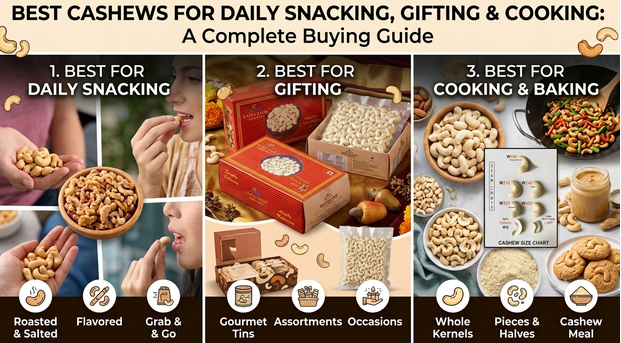
Best Cashew for Daily Snacking
W240 or W320
For everyday eating, W240 and W320 are practical choices.
W240 offers larger, fuller kernels with a premium eating experience, while W320 provides good value with whole, uniform cashews. The choice largely comes down to how much you want to spend on size and presentation. For regular office snacking, breakfast bowls, trail mixes or simply eating a handful during the day, you don’t necessarily need the biggest cashew available.
Tip: Choose plain, fresh cashews when you want to judge their natural quality. You can always choose roasted or flavoured varieties for a ready-to-eat snack.
Best Cashews for Gifting
W150 or W180
When appearance matters, larger cashews make a stronger impression.
W150 is an extra-large premium option, while W180 is one of the largest commonly traded whole-kernel grades. Their size and uniform appearance make them suitable for festive hampers, corporate gifts and premium dry-fruit boxes. (Sahyadri Nuts)
For gifting, look for:
- Large, uniform kernels
- Clean ivory or pale colour
- Minimal broken pieces
- Fresh aroma
- Good-quality airtight packaging
Best Cashews for Cooking
W320, W450 or Cashew Pieces
If you’re making gravies, curries, desserts, sauces, cashew paste or nut-based recipes, paying extra for jumbo whole cashews may not be necessary.
W320 offers a good balance for general household cooking. For recipes where cashews will be ground, chopped or blended, pieces and splits can be more economical because the original shape of the nut doesn’t matter.
For example:
- Kaju curry: W320 or pieces
- Cashew paste: pieces
- Kaju Katli: W240/W320 or suitable pieces
- Gravies: W320 or pieces
- Baking: smaller grades or pieces
- Garnishing: W240/W320
- Festive sweets: W240/W180 depending on presentation
How to Identify Fresh, Good-Quality Cashews
The grade is only one part of the buying decision. Look beyond the number on the packet.
1. Check the colour
Good white-whole cashews generally have a white to pale ivory appearance. Avoid kernels showing obvious mold, infestation or unusual deterioration.
2. Look for uniformity
A pack labelled as a particular whole grade should contain reasonably consistent-sized kernels.
3. Check the aroma
Fresh cashews should have a pleasant, natural nutty aroma. A stale, rancid or unpleasant smell can indicate poor storage or deterioration.
4. Check the texture
Fresh cashews should have a satisfying crunch rather than feeling excessively soft, rubbery or stale.
5. Check the packaging
Look for:
- Airtight packaging
- Batch details
- Manufacturing/packing date
- Best-before date
- Food-grade packaging
- Proper storage instructions
6. Don’t judge quality by size alone
A W180 cashew is larger than a W320, but grade primarily tells you about size/count and kernel integrity—not that one grade automatically has superior nutrition. Your choice should depend on the intended use, freshness and overall quality.
W150 vs W180 vs W240 vs W320: Which Should You Buy?
For daily snacking: W240 or W320
For premium snacking: W240 or W180
For gifting: W150 or W180
For cooking: W320
For grinding/pastes: Pieces or splits
For baking: W320, W450 or pieces
For premium desserts: W180 or W240
The key is simple: choose the grade according to the purpose, not just the size.
How to Store Cashews
Cashews contain natural oils, so proper storage is important.
- Store them in an airtight container.
- Keep them away from direct sunlight and heat.
- For longer storage, refrigeration can help maintain freshness.
- Avoid repeatedly opening a large container if you consume cashews slowly.
- Buy an appropriate quantity rather than storing unnecessarily large amounts for long periods.
Frequently Asked Questions
1. Which cashew is best for daily consumption?
W240 and W320 are practical choices for everyday consumption. W240 offers a larger kernel, while W320 generally provides a more economical whole-cashew option.
2. Is W180 better than W320?
Not necessarily. W180 is larger, but the grade primarily reflects kernel size/count. W320 can be an excellent choice for everyday snacking and cooking without paying extra for jumbo size.
3. What does W320 mean in cashews?
W320 refers to whole cashew kernels with approximately 300–320 kernels per 454 g. It is a widely traded whole-kernel grade.
4. What is W240 cashew?
W240 refers to whole cashew kernels with approximately 220–240 kernels per 454 g. They are larger than W320 and are commonly used for snacking, retail packs and premium applications.
5. Are W150 cashews worth buying?
W150 can be worth considering when large size and premium presentation are important, especially for gifting. For routine cooking or snacking, a smaller grade may offer better value.
6. Which cashew is best for gifting?
W150 and W180 are suitable when you want large, visually impressive kernels. W240 is another practical option for premium-looking gift packs.
7. Which cashew is best for cooking?
W320 or smaller grades/pieces work well for many cooking applications. If the cashews will be ground or blended, pieces can be a cost-effective choice.
8. Can I use broken cashews for cooking?
Yes. Broken cashews and pieces can be particularly useful for gravies, pastes, sweets, baking and desserts, where the whole-kernel appearance isn’t important.
9. Does a bigger cashew mean better nutrition?
No. Size alone should not be treated as a nutritional ranking. W180 is simply larger than W320; freshness, preparation and portion size are also important considerations.
10. How can I tell if cashews are stale?
Look for an unpleasant or rancid smell, stale taste, excessive softness or other signs of deterioration. Properly stored cashews should retain their characteristic nutty aroma and texture.
11. Should I buy raw or roasted cashews?
It depends on how you want to use them. Raw/plain cashews are versatile for cooking and recipes, while roasted cashews are convenient for ready-to-eat snacking.
12. Which cashew gives the best value for money?
For many households, W320 offers a useful balance of whole-kernel quality, size and price, while W240 can be chosen when you want a larger premium-looking kernel. For cooking where the cashew is ground or chopped, pieces can provide additional value.
Final Buying Guide
The best cashew depends on what you’re buying it for:
W150/W180 → Premium gifting & jumbo snacking
W240 → Premium everyday snacking & gifting
W320 → Everyday snacking & cooking
W450/Pieces → Baking, grinding & cooking
So, instead of asking “Which cashew is the best?”, ask “Which cashew is best for my purpose?” That’s the simplest way to get the right combination of size, quality and value.