

Cashews are one of the most loved dry fruits — creamy, nutrient-dense, and perfect for snacking or cooking.
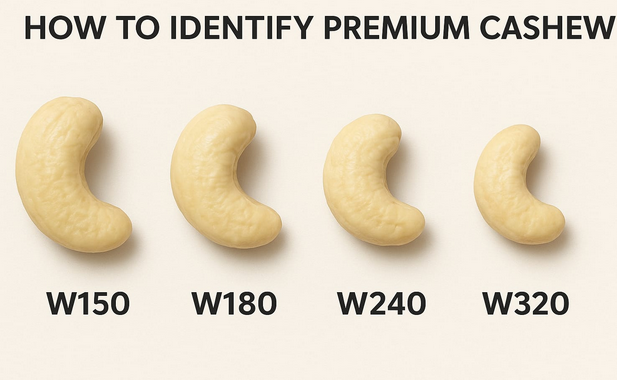
But when you shop for cashews, you’ll often notice labels like W150, W180, W240, W320.
What do these grades mean?
And how do you identify premium, high-quality cashews?
Let’s break it down.
What Do Cashew Grades Mean?
Cashew grades represent:
✔ W – “White”
Indicates color, cleanliness, and quality (ivory-white, whole nuts).
✔ Number – Nuts per pound
The higher the number → the smaller the cashew size.
So:
- W150 = ~150 nuts per pound → Bigger than W180; very premium and rare
- W180 = ~180 nuts per pound → Largest widely available grade
- W240 = Medium-large
- W320 = Most common, slightly smaller
Why Size Matters
Bigger cashews → more premium:
✔ Rarer
✔ Visually luxurious
✔ Higher market value
✔ Preferred for gifting, gourmet cooking, sweets
Smaller cashews (W320) → excellent for daily cooking and snacking.
Cashew Grades Explained
🏆 1. W150 – Super Premium / Jumbo Cashews (Largest Grade)
Features:
- Largest size available commercially
- Extremely rare and in limited supply
- Thick, buttery kernels
- Ideal for luxury hampers, elite gifting, premium desserts
Price: Highest among all grades
Also Known As: Jumbo Cashews
👉 SAHYADRI W150 Cashews – Jumbo Premium
🥇 2. W180 – Premium / King Size Cashews
Features:
- Largest commonly available grade
- Uniform size
- Rich, buttery taste
- Great for gifting, sweets (Kaju Katli), roasting
Price: Very high
Common Name: King of Cashews
👉 SAHYADRI W180 Premium Cashews
🥈 3. W240 – Classic Large Cashews
Features:
- Slightly smaller than W180
- Highly versatile
- Excellent for sweets, gravies, snacking
Price: Moderate
🥉 4. W320 – Most Popular Everyday Cashews
Features:
- Best value-for-money
- Perfect for regular cooking
- Most widely used in households
- Same nutrition, smaller size
Price: Affordable
How to Identify Premium Quality Cashews (Any Grade)
✔ Bright white/ivory color — avoid yellow or grey
✔ Whole kernels — no broken pieces
✔ No black spots / oil marks — indicates fungus or storage issues
✔ Fresh smell — should be neutral, never sour
✔ Crisp texture — rubbery = stale
Which Cashew Grade Should You Buy?
| Use Case | Best Grade |
| Gifting / Premium Hampers | W150 / W180 |
| Sweets (Kaju Katli, Halwa) | W180 / W240 |
| Daily Snacking | W240 / W320 |
| Cooking (Gravies, Tadka) | W320 |
| Budget-Friendly Bulk | W320 |
Highlighted External Sources for Validation
Here are trusted external references for cashew grading standards:
Grades explained by a cashew-supplier site: “Whole Cashew Kernel Grades” from North India Cashew Company — describes W180, W240, W320 etc.
Cashew grade guide from All India Cashew Convention — lists W180, W210, W240, W320 (kernels per 454g) and explains “White Wholes” standard.
Quality-check guidelines from Kimmy Farm — explains how to identify high-quality cashew kernels (color, wholeness, absence of spots, dryness) irrespective of grade. Kimmy Farm